
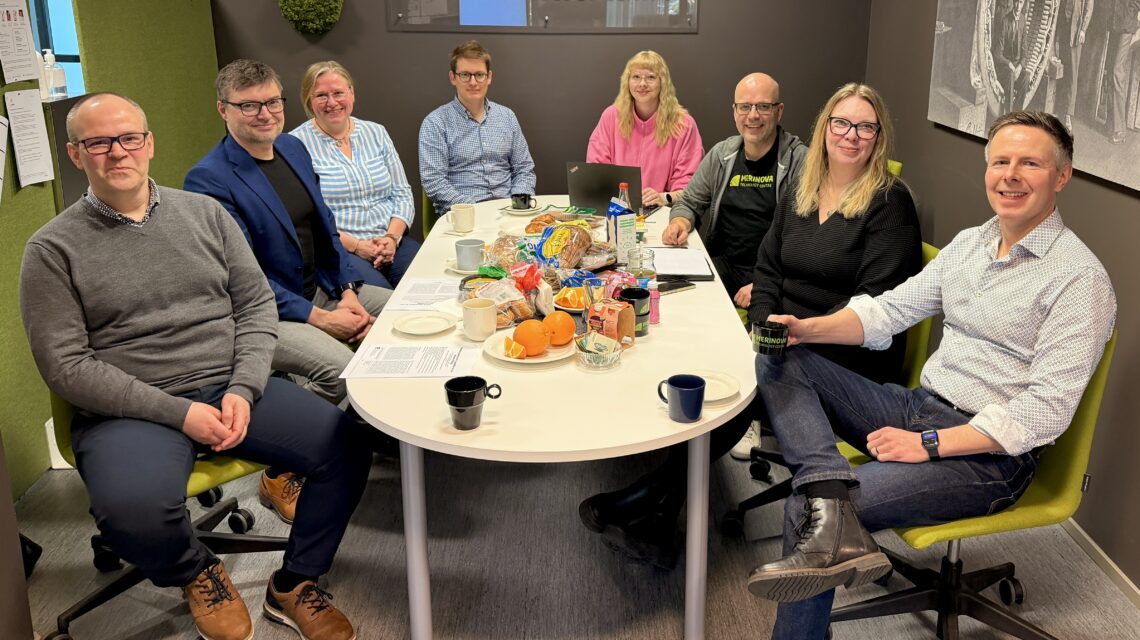
On Friday, 10 April, Merinova welcomed Andreas Lundell, Associate Professor in Information Technology, and Stefan Backlund, Project Manager from Åbo Akademi, to its morning coffee session. The discussion provided insights into Åbo Akademi’s education and research in information technology, as well as the role of AI, data, and energy technology within the Vaasa energy cluster.
Åbo Akademi and IT education in Vaasa
Åbo Akademi has campuses in Turku and Vaasa, and its information technology education is part of the Faculty of Science and Engineering. In Vaasa, the focus is on master’s level education in information technology, closely connected to the region’s energy cluster and industry. A corresponding two-year master’s programme in energy technology is also offered.
The Master’s Programme in Information Technology is delivered in Swedish and English and attracts students from around the world. The programme emphasises practical learning and close collaboration with industry, for example through extensive project-based courses. These courses give students the opportunity to work on real-world development challenges, and have even led to the creation of new companies.
Around the coffee table
During the session, key research themes within Åbo Akademi’s information technology were discussed, many of which are closely linked to the region’s industry and energy systems.
The main focus areas include:
🔹 Intelligent and sustainable data-driven industrial processes
🔹 Energy-efficient data centres
🔹 Mathematical optimisation and modelling of production and energy systems
🔹 Social robotics and human–AI interaction
One emerging research area is the electrification of maritime transport and industry, along with the related challenges for energy systems. Research is carried out in close collaboration with regional companies, for example in the automation of emissions calculations and the development of data-driven solutions. Åbo Akademi is also involved in several projects connected to Business Finland’s flagship programmes, led by companies such as Mirka, Wärtsilä, and Meyer.
The discussion highlighted a practical approach to AI development: work starts from real needs and challenges, which are addressed through collaboration between research and industry. AI is not replacing people, but rather acting as a tool to support expert work and improve process efficiency.
Warm thanks to Stefan and Andreas for an insightful and engaging morning coffee discussion!